
|
Sai Vichaar 01.Feature of the Week: Inwardly the same 02.Devotees Say 03.Prayer Club 04.Sai Activities 05.Experiences of Devotees 06.Quotation of the Week 07.From the Editor's Keyboard 08.Submit your article to Sai Vichaar 09.Subscribe to Sai Vichaar 10.Disclaimer From the Editor's Keyboard... Thanks to those contributors who have started to use the article submission page for sending material to Sai Vichaar. Sai Vichaar and SSBWSO request all contributors to use the contribution submission page for submitting any material to Sai Vichaar. The contributors are required to provide an author ID and use it to access the contribution page. Sai Vichaar humbly requests the cooperation of all readers and devotees in this matter in helping to expedite the processing of your contributions to Sai Vichaar. If you have any questions concerning the use of this form, please contact web site administrator. We have see in several of our earlier discussions various similarities and differences amongst religions of the world. The beauty of Sai message may lie in its simplicity. Question of the week for this week is How does Sai philosophy differ from organized religions? Humbly yours, The Editor
Disclaimer Sai Vichaar is devoted to the philosophy and teachings of Shri Sadguru Sai Baba of Shirdi, and will take every measure to avoid topics or themes contradicting the same. Sai Vichaar team or the Shirdi Sai Baba web site organization is not responsible for the opinions expressed by individual contributors.
|

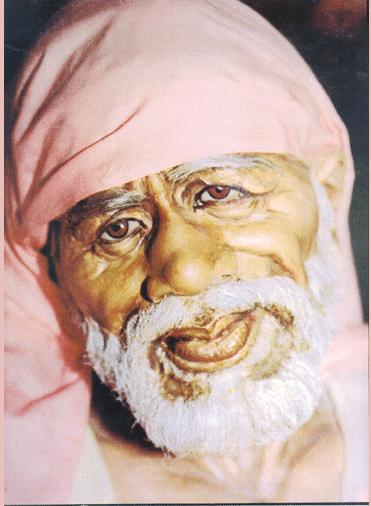
Feature of the Week: Inwardly the Same If Sai Baba was a Sufi saint, one may ask, how is it that he has been so readily interpreted and embraced by the Hindu community? Deccani Sufism with its poet-saints has similarities with the strong devotional heritage of the Bhakthi movement of Central India. Echoing the devotional goal of God-realization of both the Sufis and the bhakthas which the former call ma’rifa and the latter brahmavilasa. Sai Baba said, "reaching God is the aim". Although the eleventh-century Muslim scholar, Alberuni, visiting India declared, ‘ The Hindus entirely differ from us in every respect’, at the mystic and devotional bhakthi level there is a fundamental similarity of thought and practice, and indeed they share the same goal to have a direct experience of God. Their inner experiences tally closely, although externally they may appear very different - in their customs, languages, rituals and appearance. In climbing to the top of spiritual mountain, it can be said that the Sufis take a direct structured route with formal way-stations, where as the bhakthas take a more informal, gentler path, but both eventually reaching the summit. Once a bhaktha is able to transcend the boundaries of his formal religion he enters into a state common to all mystics. The Sufi goes beyond the Muslim law (shar’at) and is preoccupied with the way to enable him to experience (tariqat) the ultimate reality (ma’rifa). The poet saints were also intent on proclaiming through their poetic outpourings how to reach God-realization, placing great stress on saying the name of God (namasmarana), a practice which the Sufis also embrace (dhikr). Essentially they are no different.
(From "Unravelling the Enigma, Shirdi Sai Baba in the Light of Sufism" by Marianne Warren)
Sumita Kanungo
JayaSree, Malaysia
Manohar Adusumilli
MRK, Phoenix, AZ, USA
S.V. Swamy, Hyderabad, AP, India
When we pray, as I said earlier, our motives are very important. We have been given enough talents and resources by our Maker to carry out our tasks. Only problem is, most of us don't remember what we have set as our task when we took birth on this earth plane. Either because of selfish desires (to become very rich, famous or powerful etc.), or because of our emotional attachments to some other persons, (could be friends or relatives), we start praying, i.e. ask the Higher Entity for more than we may need. Our needs are very few but our wants (desires) are so many that even a hundred births may not be sufficient for them to be fulfilled. When we pray for a stranger, our motive could be a desire for fame (the person who got benefited by our prayer may tell others), money (that person may out of gratitude donate generous amounts to our activities), or a hope that if we pray for others now, others will pray for us when we need the divine help. In the last reason, there is one underlying implication that by praying for others, we generate good karma (a good impression in the books of Destiny) and this will come to our aid when we are in trouble. The above may shock some of our friends. Many of us are not aware of our motives in doing something. Most of the time, our vision is turned outwards. The English word "Insight" is very relevant. It is a good translation of our Sanskrit word, "Antarmukhatva", which literally means facing inwards. We think our motives are very good and we are acting selflessly when we pray for others. It is not that we should not feel for others, who are suffering. There are people who are truly self-less in their actions. They may kindly ignore this discussion. Why do we feel that we should pray for ourselves or for someone else? Because we feel helpless on our own! Because we have not put enough effort to get the desired result but still want the result (Like A student who has not prepared adequately for the examination but who prays to God to forgive him and pass him)? Or because we have done all that is possible but are not ready to accept the negative result? Do we pray because we lack full faith in God? Of course, the person who prays has some faith in God. Otherwise, (s)he wouldn't pray at all. Does He not know what we need or deserve? Or do we pray because of anxiety about the impending outcome? Do we at any time try to analyze these aspects of prayer? We always pray for good and positive results for our dear ones or for ourselves. We sometimes (not always) pray for bad things to our enemies. You object to my use of the word 'pray' in this context, is it not? You may say that we don't pray, we may just wish, or if we are very angry with some person, curse him or her. Well, what is the difference between praying, wishing and cursing? They are all actions with our mind. We set off some thoughts, which reach the Deity to whom we address them. We may vocalize them or write them down in prayer, but that is only to help us in focussing our thoughts. Whether we vocalize them or not, thoughts are the means of achieving our goals. Thoughts, which are colored by emotions, precede all our actions. Many of the Yagnas, Yagas etc. are also performed for Universal welfare or for achieving a specific purpose, but Sarpa Yaga was performed by King Janamejaya to destroy all Snakes, because one of them 'Takshaka', was instrumental in killing his father, Parikshit. Similarly, Sukracharya, the priest of Daityas, (i.e. Rakshasas), used to perform various rites to give power to his disciples so that they can defeat Devatas. Thus prayers, rituals, Pujas etc. can be done with negative thoughts too. As long as we want positive fruits of our actions, we must also, be ready to accept the negative results. It is a law without exceptions. If we don't want to accept the negative results, we must then obviously not expect Any positive results also. If we don't want either positive or negative results, then why should we do karma? We can as well sit quietly, doing nothing. But is it possible for any of us to sit quietly doing nothing? It is impossible. Even if we don't do any karma with our body, we will still be doing karma with our mind. Doing Tapas, Dhyana, Meditation, anything in fact is doing Karma. Lord Krishna emphatically tells in Gita that it is impossible for any living being to be without doing karma. Unless we have mastered the technique of meditation such that our mind becomes totally blank, some thought or other will keep rising like a wave in the sea, in our mind. But can we maintain that blank state? The moment we come to normal state, we start thinking. And thoughts beget us karma, positive or negative. So whether we want or not, when we pray for others or for ourselves, we will be acquiring positive or negative karma. The only way of avoiding karma is not to want any result from the karma, i.e. detachment. Sri Krishna talks of Nishkama Karma, i.e karma without desire. Desire for what? For the results of karma. But is it possible? Not if we maintain our sense of duality (from Him) and not if we think that we can cross this ocean of Samsara on our own. That is, ego, and pride are the main obstacles for us to get rid of kama, desire. Then what is the way? Sri Krishna tells Arjuna that the easiest way for liberation from this cycle of birth and death (which is caused by our karma, which in turn is caused by our Attachments or desires for the fruits of our actions), is to surrender totally all our actions and the fruits of our actions at the feet of the Lord. (Sarvam Sri Krishnarpanamastu!) To conclude, when we try to apply the above to our topic of prayer, what do we get? We must accept that prayer is also karma. We pray for some material or spiritual benefit because we either want more than what we deserve to get, or because we are not ready to accept failure as our due. Many times, with our shortsightedness, we are unable to accept an apparently negative result as His way of preparing us for better things, which lie round the corner. Thus when we pray for success in an examination or a job interview and when we don't get what we prayed for, we are disappointed and we feel that God has not responded to our prayers. We fail to realize that He has planned something different for us, which in His view is better for us. In our immaturity, we don't realize all this. We feel that He is not listening to our prayers and start enlisting other's help. We request our friends, relatives or some other sympathetic souls to pray for us, to help us to realize our desires. Are we being immature in thinking that God will do something different in our case, if we enlist the support of some more devotees? In addition, are we burdening others with our karma? These are the questions which we must ask ourselves. I seek the forgiveness of all readers, if I had caused any confusion by the discussions on prayer, which I have presented from my logical point of view. But in the beginning itself, I submitted that logic and faith are poles apart. Prayer, in the end, is a matter of faith. Logic depends on your mind but faith is a servant of your heart. So let your heart, i.e. your faith, guide you in this matter. Rajesh Routhu, Rochester, NY, USA rrouthu@hotmail.com
Rajesh Wattal, TX,USA
Sai Utsav 2000
Sai in Annadanam -17 and 18 - Saidarbar, Hyderabad, India
S.V. Swamy, Hyderabad, India
Once the strings are entrusted to the Sadguru there is no cause for grief - Sai Baba (as cited in -Sai Baba the Master- by Acharya E. Bharadwaja.)
|

© 1996-1998 by Shirdi Sai Baba web site Organization, all rights reserved.
