
|
Sai Vichaar 01.Feature of the Week: : Baba's message through Javhar Ali's episode 02.Contributed Article: Unusual Words and Sounds 03.Experiences of Devotees 04.Devotees Say 05.Sai Activities 06.Prayer Club 07.Quote of the Week 08.Question of the Week 09.Subscribe to Sai Vichaar 10.Email Newsletter to a friend 11.Submit Articles to Sai Vichaar 12.Un-Subscribe Sai Vichaar 13.From the Editor's Keyboard 14.Disclaimer From the Editor's Keyboard... Sai Vichaar and Shirdi Sai Baba Web Site Organization extend their warm wishes to those helpful in getting Shirdi Sai Baba Chitra Yatra 2002 to a successful start. Please refer to Sai Activities section and (link) for more details. Those willing to participate in this unique spiritual event highlighting Sai devotion and Baba's message of universal love and goodwill, please contact the web site administrator. We have seen in several of our earlier discussions various similarities and differences amongst religions of the world. Never before the significance of Sai philosophy has been more profound than the present times, as the world events suggest. Question of the week for this week is, How does Sai philosophy differ from organized religions? What benefits would one derive from the life and teachings of Sai Baba of Shirdi in this respect? Humbly Yours, The Editor
Disclaimer Sai Vichaar is devoted to the philosophy and teachings of Shri Sadguru Sai Baba of Shirdi, and will take every measure to avoid topics or themes contradicting the same. Sai Vichaar team or saibaba.org is not
responsible for the opinions expressed by individual contributors.
|
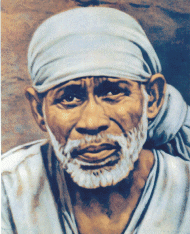
 Feature of the week: : Baba's message through Javhar Ali's episode Sai Baba met one fakir Javhar Ali about five years after his wrestling match with Mohiddin Tamboli. This fakir was learned and a scholar of Koran and had a sweet tongue. He started living in Rahata along with his disciples and bewitched the religious and devout people of Rahata. He came in some conflict with villagers when he started to build an Idgah [a wall before which Muslims pray on Idgah day] near a Hindu temple. As a result, Javhar Ali had to leave Rahata and he went to Shirdi. He started living with Baba. Here also, people were captured by his sweet talks. He gradually started calling Baba as his disciple. Baba did not object and consented to be his disciple. Then both Guru and Shishya decided to return to Rahata and live there. Javhar Ali did not know the worth of Baba but Baba knew the shortcomings of his so-called 'guru'. Nevertheless, he served Javhar Ali as his Guru with respect and sincerity. The loving devotees of Baba did not want him to stay away from Shirdi. So, they went to Rahata to request him to return to Shirdi. They faced the wrath of the ill-tempered 'Guru' of Baba for trying to take Baba back to Shirdi. However, after some discussions, both Guru and Shishya returned to Shirdi. A few days later, a person by the name of Devidas tested the Guru. Devidas was a dispassion incarnate and a jnani. He lived in Maruti temple in Shirdi and many villagers of Shirdi regarded him as their Guru. They brought Javhar Ali in Devidas' presence and in the discussion that followed, Javhar Ali was defeated and he fled from Shirdi. Several years later, when he returned to Shirdi, he prostrated before Baba. His delusion that he was Guru and Baba his shishya was cleared. Seeing his repentance, Baba treated him with respect. This is the basic story. There are a few interesting aspects in this story. The question arises as to why Baba accepted the discipleship of an unknown fakir. Was it because of his Muslim background In 'Life of Sai Baba', Narasimhaswamiji tells us that when Javhar Ali came to Shirdi, he saw that Baba [who looked Muslim in his appearance] had a Hindu following, worshipping him at the Masjid. He called upon Baba and asked him whether he knew the Koran and the Sharia't. Baba said he had learned neither. Thus, the fakir ordered him to accompany him to Rahata, evidently for some religious training. Baba went along with this command in spite of his knowledge of Javhar Ali's shortcomings. He observed his duties to his Guru respectfully and carefully. Sai Baba's acceptance of Javhar Ali as his Guru, particularly when Baba had already established himself in the hearts of his Hindu devotees, emphasizes his equanimity and humility. Baba's decision to stay with the fakir must have made the Muslim minority of Shirdi happy, as they perhaps needed some assurance that Baba was of Muslim background. On the other hand, Hindu people of Shirdi going to Rahata to bring Baba back to Shirdi shows Baba's popularity amongst Hindus. Sai Baba treated Javhar Ali with respect when Javhar Ali repented and
asked for Baba's forgiveness. As in many cases, here also Baba showed
through his own conduct how one should get rid of egoism, how not to
harbor any grudges and how to do the duties of a disciple in order to
receive knowledge.
Contributed Article: Unusual Words and Sounds
On Christmas holiday, I went to my sister and brother-in-law's house.
It is here that my multi-faith family gathers with their children to
celebrate the exchanging of gifts in remembrance of a great Avatar
spirit. For the children, it is a time of joy where Santa Claus is the
presiding deity. For the elders, it is a time to meet and share our
affections.
After some time, I went upstairs and sat at my 12-year-old nephew,
Kirk's computer, and opened the Sai Baba.org Website. I was at the Home
page of the Website, listening to the chant as my nephew ran up the
stairs, brushed past me, and stopped to glance at what he considered
peculiar graphics and music. He said to me, "Wow, that's scary!" while
he looked at Sri Sai seated upon his chair with torch flames flickering
alongside him. One of my cousin's children raced upstairs, and dragged
Kirk into his bedroom to play new games on the Sony Play station. I
chuckled to myself, "They are probably going to play some video game
which I would find even more frightening than his mind found Sai Baba's
image."
Some minutes passed. My niece came upstairs, and leaned over to look
at what I was doing on the computer. I showed her an article I wrote
some weeks ago and she laughed when attempting to pronounce words that
were foreign to her. She remarked, "Babu, I can't even read this stuff!"
I read some sentences to her and my eyes twinkled with love as I
pronounced Dattatreya. Lynda laughed, gave me a hug and then walked into
her room. I smiled and thought about how easily I could explain this to
her in a language that she was accustomed to. Lynda is a very gifted
student attending one of the best colleges in the United States. Her
levels of knowledge in certain areas already far exceeds my own. I am
very fortunate to be related to Kirk and Lynda.
I think about how we project our own thoughts and belief structures
into everything we experience. Each person projects his or her desires
upon the whole landscape of reality. Our Inner Being projects what Carl
Jung termed 'the creative unconscious', upon the screen of our inner and
outer world. This power is the force of Creation, as well as the force
behind the illusory nature of all that is. It is how we perceive God
that allows God to project through our own creative potential. Our own
mind projects into reality how we perceive Sainath.
My religious background is based in a Judeo-Christian culture. It was
my destiny to journey beyond its boundaries in order to expand my
understanding of Self. My religious background gives me a deep affinity
with Sai Baba devotees. Prayer and the miracles of the Christ are the
same prayer and miracles attributed to Sai Baba. This form of worship
was already developed during my childhood. My Gurudeva, Muktananda Baba
sent me to Shirdi because this was where I was destined to fulfill a
very important aspect in my spiritual journey. It was the deepened
meditation experiences I had in Shirdi, and the further training I was
blessed to receive with my Gurus, that awakened a new dimension in my
being. Decades later, I am still only beginning to understand the
blessings that Shirdi Sai Baba disciples bestowed upon me. For some,
perhaps it seems that this is a 'holier than thou' attitude. I consider
that a projection of the mind. The Siddha Gurus I worship led very
difficult lives. Learning about their lives and their sadhana makes even
the most austere among us cower.
Samarth Baba of Akkalkot, Sai Baba of Shirdi, and Nityananda Baba of
Ganeshpuri, are beings that are unequaled in modern times. These three
Masters are the Datta lineage of my Gurudevas and the river of love that
flows from me to you. I remember Muktananda Baba telling me that during
his travels, he met with over eighty enlightened beings. He met everyone
he could find during his search. As a result, he took a great deal of
time teaching his devotees how to recognize a true Master. My Babaji
told us that he searched in the East, in the West, in the South, and in
the North, and that when he came to Ganeshpuri, he found Him in his
heart. Muktananda was initiated into monkhood by Siddharuda Swami of
Hubli; an enlightened that Shirdi Sai Baba said was one with him. My
Muktananda Baba went to arati in Shirdi for ten years while he lived in
Yeola, a town just a short distance from Shirdi. During this time, he
trained with his Gurudeva Nityananda, and came to settle in Ganeshpuri
by Nityananda's request. Nityananda sent my Gurudeva Sivanesan Swami to
Shirdi to settle there. Bhagawan sent Gurudeva Janananda Swami to
Kanhanghad to settle there. Each day in Ganeshpuri, the townspeople sing
these words during the second verse of arati, "Jaya jaya arati
Nityananda, Jaya jaya arati Nityananda, Sagunarupi Govinda, Jaya jaya
arati Nityananda, Manika Prahbu Tu hosi, Akkalkota Swami hosi, Shiradi
Sainatha hosi, Kaliyuga Nityananda banasi, Jaya jaya arati Nityananda,
Jaya jaya arati Nityananda".
I have listened to Sai bhaktas for decades saying that Sai Baba did
not leave any successors, and for the most part, I remained silent
concerning this issue; however, I believe that this is a
misunderstanding concerning the Siddha lineage. I am not asking anyone
to follow my path or change his or her mode of worship. Some Sai Baba
devotees have asked me to teach them some processes my Gurus taught me.
One of my Gurudeva's appointed successors told me years ago to begin
initiations, when I had concerns about opening up my heart. I have been
very reluctant up to now. I believe the time is ripe. The field of a
true Sai bhakta's heart is so fertile and rich. It would be my honor to
help. Aum Sri Datta Shirdi Sainatha. (To be continued) Robert Kirk: New
York
"Shri Sai Baba Chitra Yatra", support team, Saibaba.org
Rachna Taneja
Message to our dear Sai sister Meenakshi Varma: A Sai devotee
Smita Krishna
Swati
Quotation of the Week
Q. How does Sai philosophy differ from organized religions? What benefits would one derive from the life and teachings of Sai Baba of Shirdi in this respect? A.Ravin Gnanasambandam, Ithaca, NY Shri Shirdi Sai Chitra Yatra 2002 in USA The journey which involves the ceremonial travel of Baba in the form of a portrait will stop at all Baba devotees homes who are interested in being a host to his protrait. The Yatra which will run till fall of this year, is open to one and all. There is no fees or charges involved to take part in this event. You may participate either as a host home or serve as an anchor point in your community. Vist online at Sai Chitra Yatra for all the details and to register. For questions, comments, suggestions or to get details on an Anchor home
in your area, send us an email at maildrop@saibaba.org with the subject
line of "Shri Sai Chitra Yatra".
|

© 1996-2001 by saibaba.org, all rights reserved.
