
|
Sai Vichaar 01.Feature of the Week: 02.Contributed Article: 03.Experiences of Devotees 04.Devotees Say 05.Sai Activities 06.Prayer Club 07.Quote of the Week 08.Question of the Week 09.Subscribe to Sai Vichaar 10.Email Newsletter to a friend 11.Submit Articles to Sai Vichaar 12.Un-Subscribe Sai Vichaar 13.From the Editor's Keyboard 14.Disclaimer From the Editor's Keyboard... Devotees are requested to refer to Sai activities section for information about various Sai centers. Those who are willing to start Shirdi Sai Baba satsangs may share the details by writing to Sai Vichaar Sai devotees and readers are invited to contribute to the "Feature of the week". In the true spirit of Sai devotion, contributors are requested to remember the global nature of Sai Vichaar readership. Therefore, the content, language, style and presentation, appropriate to a worldwide readership will be more rewarding and fulfilling. It should also be noted that when a section from any material other than their own is quoted or referred to, it is the authors' responsibility to acknowledge the source appropriately The "Question of the week", for this week is, Q. What is the spiritual significance of a Living Sadguru? Humbly Yours, The Editor
Disclaimer Sai Vichaar is devoted to the philosophy and teachings of Shri Sadguru Sai Baba of Shirdi, and will take every measure to avoid topics or themes contradicting the same. Sai Vichaar team or saibaba.org is not responsible for the opinions expressed by individual contributors.
|
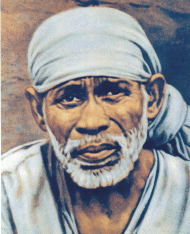 Feature of the week:
What did Dasganu Understand?
Feature of the week:
What did Dasganu Understand?
Baba's teaching method to his devotees was not uniform. Sometimes he used to narrate a story and at other times, he recommended simple events to awaken his devotees towards Spirituality. He was the master of all, and he only knew the appropriate method, time and circumstances of teaching. Chapter 20 of Sai Satcharitra gives an account how Dasganu's problem of understanding the teaching of isopanishad was solved by Baba. Isopanishad's eighteen slokas consists of Atmatatwa varnan, the life of an ideal saint who remains steady even at the time of difficulties, the principle of karmayoga etc. Dasganu translated Isopanishad to understand the real teaching of Isopanishad. But as he was not able to understand it even with its translated version and he was very dissatisfied. Dasganu thought that the person who has already accomplished Atmasakshatkar could only help him understand the real meaning of Isopanishad. Dasganu then goes to Shirdi for Baba's Darshana and ask Baba to solve his problem in understanding Isopanishad. Baba then blesses Dasganu and says when you go back the maidservant of Kakasaheb Dixit at Vile Parle will solve your problem. The people around were dubious about Baba's solution that the illiterate maidservant can solve such a complicated problem of Dasganu. They thought that it was merely Baba's joke. But Dasganu's faith on Baba's words was total and he took it as a Brahmavakya. With total faith on Baba's words, Dasganu stayed in Kakasaheb Dixit's house in Vile Parle. Next morning, when he was enjoying early morning sleep, he happened to hear the melodious song of a girl. It was Namya ka bahan who was the maidservant in Kakasaheb's house. The words in the song were describing the red sari. The song actually was appreciating the color, border and the print of the red sari. She was cleaning the pots wearing the rags as her dress. But the girl was very happy even in her wretched condition. Dasganu was touched by the girl's condition and next day he requested Mr.Pradhan to give her a new sari. When Pradhan gave her a new sari, she accepted it as a very hungry person jumps at the food provided to him. She wears a new sari and started singing the song happily as she did previously. Third day, she put off the new dress and wore the old dress but she was equally happy and steady. Dasganu was astonished to see her steadiness. He thought that she was wearing rags because of her poverty but even now when she had new sari, she was wearing the rags and looked equally happy and steady as before. There was no trace of any problem or unhappiness in her appearance. Dasganu after this event realized that happiness or unhappiness depends upon the state of mind. One has to be satisfied whatever God has given to us. Thus Dasganu understood the preaching of the Upanishad that one has to be satisfied with whatever God has given. OM SAI RAM (Contributed by Pradip Koirala)
Contributed Article:The Sage of Arunachala
Ramana Maharishi, one of the greatest sages of India, was not a mere life but a manifestation that descended on to this earth on December 30, 1879. It was a Monday and more important the `Day of the Arudra Darshan', (celebrated as the birthday of Siva). He was apparently an ordinary baby at birth. What he made out of his life, however, was extraordinary. When he was barely 17 years old and in the summer of 1896, he experienced a feeling of death and life thereafter. The aftermath of the experience left him not scarred or scared but enlightened. The boy Ramana, magnetised by the vibrations of the sacred hill Arunachala at Tiruvannamalai in Tamil Nadu, India, reached there on September 1, 1896.
He never moved out again except for his heavenly abode. Aware that the time of his departure was due, the Maharishi tried to console his devotees and assuage their grief in many words, "Where could I go?" he queried. "The body is itself a disease; when we have finished a meal do we keep the leaf plate on which we have eaten it?" Just as a servant rejoices to lay down his burden at the place of delivery, so does a Jnani rejoice at being relieved of the body by death." For a man who gave up just about everything, except his loincloth, the Maharishi did indeed have a large family of devotees. They came in hordes and from all strata of life - queens, princes, ministers, Presidents, philosophers, foreigners, musicians, the ardent seeker, the curious intellectual, the rich zamindar and the pauper. He viewed all of them with the same compassion.
In his heart there was place for all creatures great and small. His demeanor towards the quadruped, the winged and the reptiles is worth pondering over. He never referred to an animal as `it' but always as "he" or "she". When he said, "Give Lakshmi her rice at once," it was the cow whom he meant. In fact the rules of the Ashram dictated that at mealtime, the dogs be fed first, then the beggars and only then the devotees. Squirrels used to hop through the window on to his couch and he always kept a little tin of peanuts besides him for them. The animals felt his Grace and once a devotee asked him what it felt to have a snake pass over him and he replied "Cool and soft."
It was a delight to watch very young children run up the hill to be with the Maharishi. Ramani, a nonagenarian fondly recalls with tears in her eyes, "We never knew that he was a Maharishi. He was `Omachi thatha,' to all of us (children). It was Kavyakanta Ganapati Sastri, one of the earliest disciples of Bhagavan, who first addressed him as Maharishi. My father Manavasi Ramaswamy Iyer, was a great Ramana bhakta. He was a poet who composed many songs on `Bhagavan.' He was popularly referred to as Saranagati Thatha on account of the popular Saranagati song he composed on the Maharishi. But more poignant is the fact that on the day Bhagavan died, Ramaswamy realised that he could compose no more. The stream of songs that gushed out uninterrupted for 40 years dried on the day of the Mahanirvana."
Bhagavan was a simple human being. In everyday life, he was punctual, meticulous to the last detail, and simplicity incarnate. Devotees recall that he would never allow privileges of any kind to be shown to him. He shunned ostentation of any kind and refused to be garlanded on any occasion. In the dining hall, if anything extra or special was served to him he would immediately express his displeasure by refusing to eat the food. On another occasion when a devote reprimanded a European lady for not crossing her legs, Bhagavan, in spite of his arthritis and rheumatism, crossed his legs that a rule was applicable to all and refused to straighten them till the lesson had been driven home. In the last years of his life, the Ashram authorities commissioned a sthapati to carve a statue of Bhagavan. Hearing the stone being chiselled, Bhagavan jocularly remarked, "The stone God is getting ready to sit upon the stone sofa."
F. H. Humphreys, the first European visitor to the Ramanashram penned his experience, of seeing Ramana Maharishi, to a friend in London. "For half an hour I looked into the Maharishi's eyes, which never changed their expression of deep contemplation. I could feel only that his body was not the man: it was the instrument of God." But Humphreys was neither the first nor the last to experience God in the form of Ramana Maharishi. Paul Brunton, who arrived at Tiruvannamalai more a skeptic than a believer records the impact of the eloquent silence of Maharishi: "Before those (eyes) of the Maharishi, I hesitate, puzzled and baffled ... I cannot turn my gaze away from him. I know only that a steady river of quietness seems to be flowing near me ... " Scholars came to Bhagavan Ramana Maharishi to get their doubts clarified but his teachings were not theoretical in the least. In fact they were simple and practical. He would constantly urge the process of self-enquiry. His oft-repeated advice to aspirants was, "Constantly introspect - Who am I? That which is peace. All that we need do is to keep quiet. Peace is our real nature."
(Contributed by Source: "The Hindu" dated May 9, 2003)
Madhavi Rajesh Natasha Sai Devotee Sneha Sridhar Rangaswamy, Florida, USA A Sai devotee A Sai devotee A devotee Madhavi Alaparthy Sita
Quotation of the Week
Q. What is the spiritual significance of a Living Sadguru?
Shri Sai camp in Nashik Kumbh Sai Satsang in Florida, USA Shirdi Sai Satsang, Minnesota Shirdi Sai Jalaram Mandir, Houston, Texas, USA Shirdi Saibaba Sansthan of Canada, Toronto Shri Shirdi Sai Chitra Yatra in USA The journey which involves the ceremonial travel of Baba in the form of a portrait will stop at all Baba devotees homes who are interested in being a host to his protrait. The Yatra is open to one and all. There is no fees or charges involved to take part in this event. You may participate either as a host home or serve as an anchor point in your community. Visit online at www.saibaba.org and follow link to yatra page for all the details and to register. For questions, comments, suggestions or to get details on an Anchor
home in your area, send us an email at maildrop@saibaba.org with the
subject line of "Shri Sai Chitra Yatra".
|

© 1996-2003 by saibaba.org, all rights reserved.
